Product•2026-01-23
Stop Using ChatGPT for Language Learning (Unless You Do This)

Glotta Team
6 min read
Read Time
ChatGPT is the best grammar teacher in history. But for speaking? It has a fatal flaw. Here is why Text LLMs can't teach you accents, and the tool you need to fix it.
The "AI Trap"
Since 2023, the language learning world has changed. The old advice was "Buy a textbook." The new advice is:
"Just talk to ChatGPT! It's free, it knows every language, and it has Voice Mode."
On the surface, this sounds perfect. Why pay for a tutor or an app when you have the smartest intelligence in human history in your pocket?
So, you try it. You turn on Voice Mode. You have a conversation in Spanish or French. It goes well. You feel smart.
But then, you go to Mexico City or Paris. You try to order a drink. And nobody understands you.
Why? Because you fell into the LLM Trap.
You used a Text Engine to practice an Audio Sport.
The Fatal Flaw: LLMs vs. LAMs
It Reads, It Doesn't Hear.
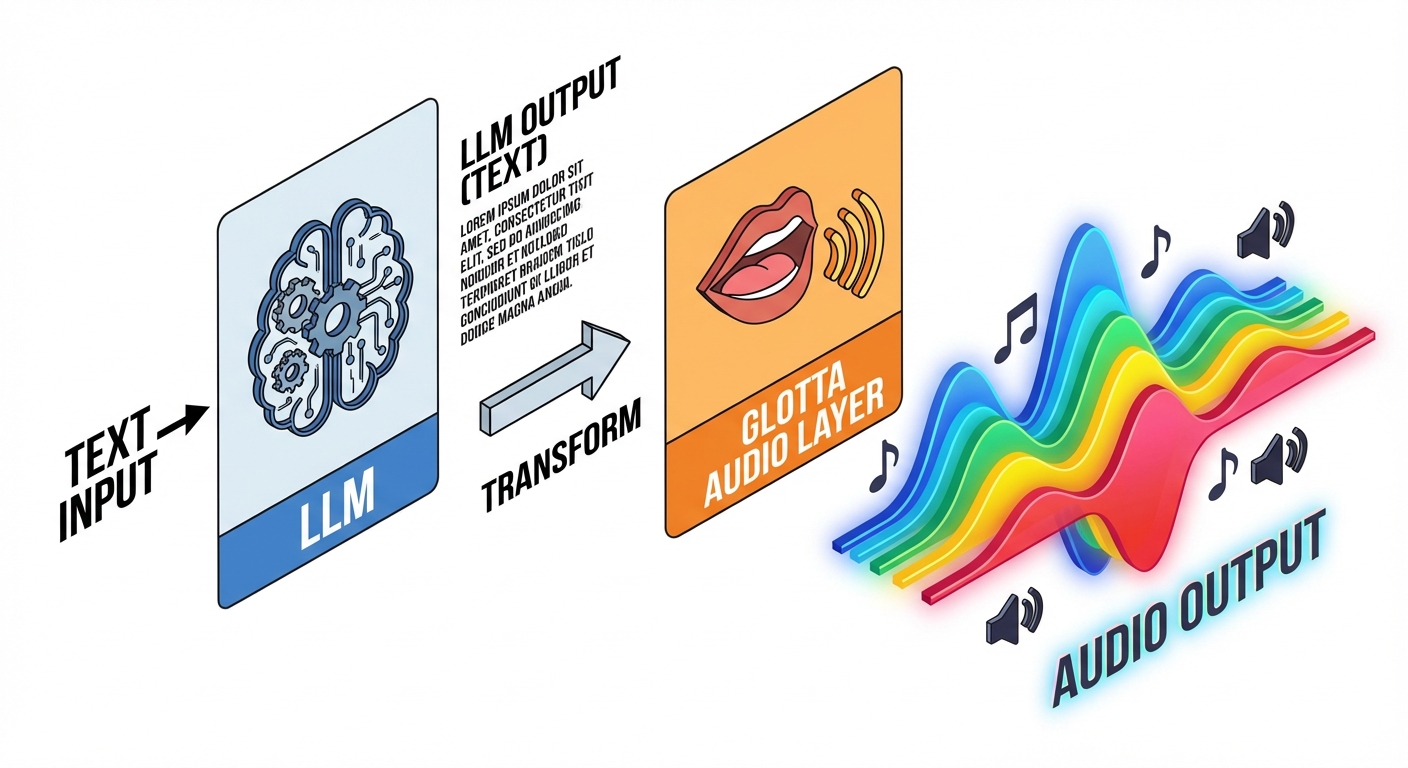
ChatGPT is a Large Language Model (LLM). It is a
statistical prediction engine based on text.
When you speak to it, your voice is converted to text (Whisper), processed
as text, and then converted back to audio (TTS).
This means ChatGPT strips away your accent. It doesn't care if
your pitch is flat or your vowels are muddy. As long as it can guess the
word, it says "Good job!"
1. The "Polite" Problem
ChatGPT is trained to be helpful and polite. If you say: "I want to eat the... uh... pomme?" with a terrible American accent, ChatGPT will say: "Yes! A pomme is an apple!"
It validates you. It makes you feel safe.
But the real world isn't polite.
A Parisian waiter won't mentally autocorrect your bad pronunciation. They will switch to English or ignore you.
2. The "Robotic" Rhythm
Even with the new "Advanced Voice Mode," ChatGPT speaks with Standardized Prosody. It speaks like a well-read audiobook narrator.
- It doesn't mumble.
- It doesn't slur words together (elision).
- It doesn't use "street" rhythm.
If you learn by mimicking a robot, you will sound like a robot.
Enter Glotta: The Audio Layer
We didn't build Glotta to replace ChatGPT. We built it to finish the job.
If ChatGPT is the scriptwriter, Glotta is the Acting Coach.
We utilize Audio-First AI technology that focuses specifically on the physics of sound—pitch, cadence, tone, and stress.
Here is the difference:
| Feature | ChatGPT (General AI) | Glotta (Specialist AI) |
|---|---|---|
| Focus | Meaning & Grammar | Sound & Physics |
| Feedback | "That sentence was correct." | "Your pitch was 20% too high." |
| Input | Synthetic TTS | Real Human / Native Audio |
| Method | Conversation | Shadowing & Drills |
The "Perfect Stack": How to Use Them Together
We are not telling you to delete ChatGPT. We are telling you to use the right tool for the right job.
Here is the workflow of the modern polyglot in 2026.
Step 1: The Architect (ChatGPT)
Use ChatGPT to generate content that interests you.
- Prompt: "Write a dialogue between two friends arguing about who is the best Batman actor, in informal Mexican Spanish."
- Result: You get a great script with slang and vocab you actually care about.
Step 2: The Coach (Glotta)
This is where the magic happens. You take that content and bring it into Glotta.
- Audio Synthesis: Glotta converts that script into Native-Level Audio with emotional range (Anger, laughter, sarcasm)—things ChatGPT often misses.
- The Shadowing Drill: You don't just "read" it. You loop the audio.
- The Feedback Loop: You record yourself saying the lines. Glotta gives you a Visual Waveform Comparison.
You see exactly where your voice didn't match the native speaker. You adjust. You record again. You get the green light.
Step 3: The Test (Real World)
Now, when you go to speak, you aren't "thinking" about the words. You have physically trained your mouth muscles to produce the sound.
Why "Good Enough" is the Enemy
"But ChatGPT understands me, isn't that enough?"
No.
"Comprehensible" is the bare minimum.
"Fluent" is the goal.
If you speak with a heavy accent:
- Listeners get tired. Processing a heavy accent takes more cognitive energy. People will subconsciously want to end the conversation sooner.
- You lose authority. Studies show that in business, heavy accents are unfairly correlated with "lower competence." It sucks, but it's true.
- You feel like an outsider. You will always be "The American guy speaking Spanish," not "The guy speaking Spanish."
Glotta is the bridge between "They understand me" and "I sound like one of them."
3 Features ChatGPT Doesn't Have (Yet)
1. Blind Mode (Ear Training)
ChatGPT shows you the text immediately. This kills your listening skills because you rely on reading.
Glotta forces you to listen first. We hide the text until your brain has attempted to decode the sound. This mimics how children learn.
2. Precision Timestamping
ChatGPT gives you general feedback. "You sound good!"
Glotta highlights the exact millisecond where you drifted off. "You stressed the 'O' here, but it should be a short vowel."
3. Infinite Repetition Loop
Have you ever asked ChatGPT to repeat a sentence 50 times? It gets annoying. It hallucinates. It changes the sentence.
Glotta is a tool. You can loop a 3-second clip 100 times until you nail it. It never gets tired. It never judges you.
Conclusion: Don't bring a Calculator to Art Class
ChatGPT is a calculator for words. It is amazing at logic, grammar, and vocabulary.
But language is art. It is music. It is physical.
You need a tool that understands the music of the language, not just the math.
Use ChatGPT to build your world. Use Glotta to live in it.